The Monthly Economic Report for February came out this past week, and while everything was down, I wanted to take the data from previous MERs to see if I could compare market regions to see where there was growth and where there was decline, specifically if the movement in Metropolis I discovered a few weeks ago was cutting into The Forge’s market share.
When comparing just pure raw trade volume, The Forge, of course, dwarfs Metropolis by several times. That is no surprise.
When looking at the log scale, a pattern emerges. Both Jita and Hek follow each other in terms of peaks and valleys. Metropolis is almost always about a month behind. This, too, is unsurprising; after all, they exist in the same universe with the same player base and the same political happenings. But if you look closely at the ends of both graphs, where Metropolis ends higher in 01/26 than in 01/25, The Forge ends lower in the same period.
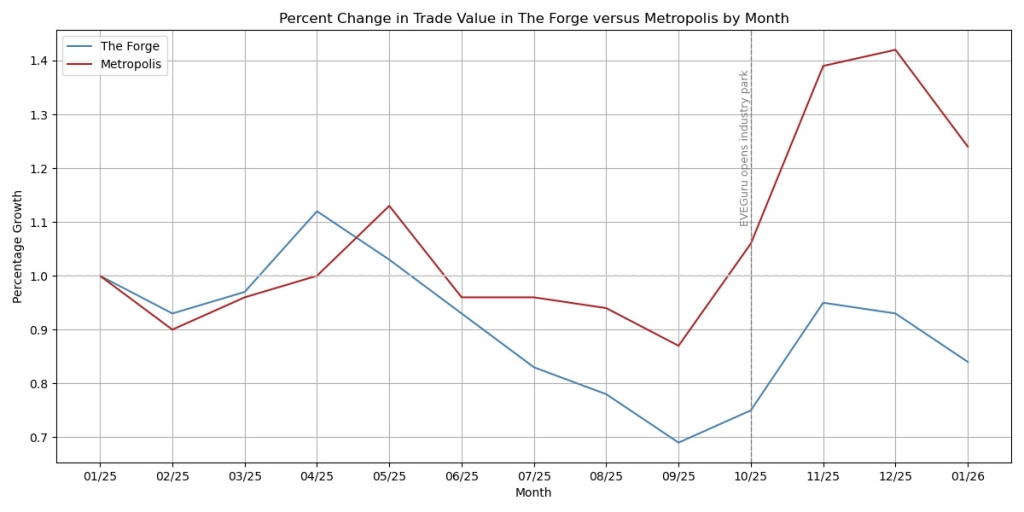
That signaled to me that there is something going on in those particular markets and led me to this graph below:
In pegging performance to the beginning of 01/25 and its relative position throughout the year, Metropolis’ trade value grows quite significantly over time, whereas The Forge has been slowly declining over the past year in comparison to where it was in 01/2025.
There is something behind this growth from September until peaking in December. The implosion of PanFam in November clearly is what caused the contraction in both markets.
I’ll temper my earlier conclusions that we are seeing Metropolis’ growth from EVEGuru Foundries in Metropolis, because while that is likely helping, Metropolis grew rapidly the month before. So, whatever is elevating Metropolis at that growth rate, EVEGuru Foundries is clearly going to tap into the existing market growth should it continue. This is also to say that while EVEGuru has yet to release production rates using their manufacturing rigs, it is unclear if EVEGuru will affect markets to any degree. It is too early to tell.
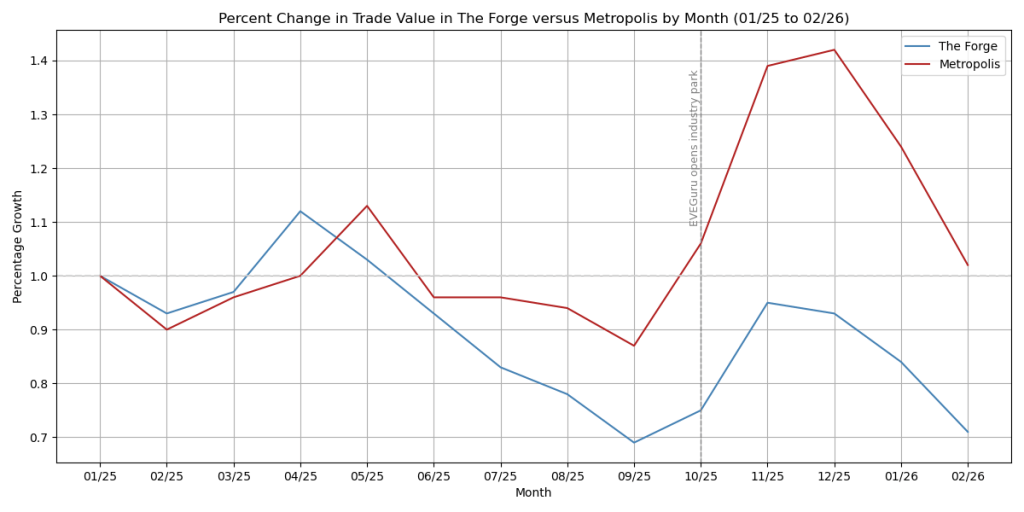
When graphing the trade data with MER February 2026’s data, above, we are seeing that both regions are starting to slide in earnest. If your portfolios are looking a bit rougher than usual, you are not imagining things.
What is going on there is, of course, subject to further exploration in The Forge and the subject of next week’s brief. Is it due to sov null being too quiet (as mentioned above, PanFam’s implosion did burst both markets’ gains), seasonal trends in the user base, or due to timing based on FanFest and expansion plans?
Like the seasons, markets do come back to life eventually, and we’ll see if spring (or lack of) weather in the Northern Hemisphere or FanFest/Expansion help get the markets back in the right direction. Ultimately, with the New Player Experience likely to shake the markets up come later this year, and rumors of changes in market hubs, looking closely at the data seems to be pointing that change is afoot and The Forge/Jita’s dominance is potentially looking threatened.
As always, interested in your thoughts. Write a comment or ask a question below.
If you want to catch my market briefs, like this one, be sure to subscribe to the blog. When a post goes live, you’ll get my post directly into your inbox. Don’t plan on having a regular day to post, so subscribing is the only way you will see everything and stay up-to-date.
No ads, no AI (anymore), no BS.
Sources
Python
Jypter Notebooks
Monthly Economic Reports 01/25-01/26 found on EVE Ref
CrazyKinux revived EVE Online Banter, which was popular among the EVE Online blogosphere when the shift to streaming and video “content” began, and is now calling it: New Eden Banter, so here I am joining the conversation. I am going to stick with economics and data because that is what I cover here, and I don’t want to get too far from the “role play” if I can help it.
Prior to last year, and really for half a minute in 2023, I have been in and out of EVE for a long time. I started playing the game in 2011, fresh out of college, and was seeking something to sink my free time into. I didn’t do much, enjoyed mining, but just mining and selling my ore couldn’t sustain a membership long term. It wasnt until 2023 when I took the Google Data Analytics Career Certificate and other data analysis certificates in Python and R (and joined the right corps) that EVE became sticky for me to a much greater degree. When rejoining last year, I used my programming skills, which led to writing market reports. I actually started writing poetry after leaving because the death glares of r/eve started to turn into anxiety and stress.
But why has EVE stuck around for 23 years? That is the topic for New Eden Banter #1, and I will take a look at my narrow scope of the market and economic reasons why EVE has stayed alive and popular with players, many of them long-term players.
In short, the game’s backbone is based on the player economy. Goons can’t rip apart their opponents without ships, and ships cost money to build (and buy); players just can’t ignore the whims of the market without potentially losing a lot of ISK. To me, the market economy is what cements the level of immersion that is long-lasting.
Market PvP: The 0.01 ISK Wars
There is something really engaging for me when I see a market economy this developed in a virtual world. Coming from Second Life, where the currency is connected to real funds, the idea of a digital, liberal market economy flourishing in a video game is not inherently strange to me. Unlike fantasy MMORPGs where the currency is in gold, silver, and copper, ISK and the marketplace operating like real life currency and the real life stock and commodity markets and that is unique in the sense that because not a lot of games offer such an intense level of a free market simulation and that supply and demand are fundamentally in the hands of the players, but without an IRL economy to keep the market going. You don’t really get that with other games and virtual worlds where real money trading is built in; that space is highly regulated.
CCP has said ISK is not exchangeable for real cash due to the fact that they want the players to effectively have free rein in the economy. If someone wants to scam the money out of another player, CCP is not going to step in and force the scammer to pay the other player back, among any number of illegal money schemes that EVE players perpetrate on the daily. If one wanted to do that with convertible currency, CCP would be shut down almost immediately for.
Then if you want to be a stockbroker wannabe like me, if you want to try your hand at day…I mean…station trading to make that sweet ISK, there is nothing like the thrill of playing the 0.01 ISK war game, and if you are a whale of a size that has the money and the order depth, or the chutzpah of a whale, there is always market manipulation for driving markets wild. Even hardcore and grizzled PvPers are also inherently playing the 0.01 ISK war because ships need to be replaced, and that runs through the mineral markets, which run on tight margins, and are subject to market speculation. Scarce minerals mean scarce ships means scarce battles.
That is key to EVE’s depth, requiring all players to care about the economics, which rewards engagement with the game and the game’s mechanics, and that can drive a game for 23 years.
Data In, ISK Out
Perhaps what makes EVE unique is that CCP publishes an API, with all the data freely available to players. This has not only allowed for an expansive third-party tool ecosystem, but for industrialists and station traders, this is key to building out an empire. In other words, how does a game that is infamously known as “Spreadsheets in Space”, with an official Excel add-on that was built by a Microsoft team, operate without data?
This is what really made the game stick for me. This gave me a reason to try manufacturing and station trading, and after finding Adam4Eve’s API the game became much more sticky for me to stay around. Not only am I learning and practicing my coding skills, but I am also feeling like an important part of the game that I enjoy. PvP is not my favorite part of the game, but if I use my analytical skills and boost my programming skills, all the better, and it helps other players make better decisions on their market moves, that’s golden.
It also makes the immersion better because, despite being on the outside of the game, I can still “play” the game while I am not connected to the game client. The best and longest-lasting games know that if there is no user community “playing” the game outside of the program, the community cannot really form and allow for emergent gameplay inside.
The Visible Hand of the Market
The one thing that keeps the market from going totally off the rails is CCP visibly managing the market when the market is going to cause gameplay issues. Look at the case of my posts on pyerite and asteroid mining, CCP was forced to reckon with the fact if they didn’t fix pyerite’s price, it would have caused issues that would have led to an exodus of players of all stripes. This is also where having a real-life economist on staff is helpful, but I would argue this is helpful for players like me who have access to this kind of data and can give feedback (however informed or ill-informed as you and I may be).
Like the real-life market, governments often step in and course-correct the markets, so the market doesn’t wreck the day-to-day economy. CCP understands that their game is dependent on a healthy and moving market; any type of stalling will inevitably puncture gameplay and time in the game. Linden Labs/Second Life has a similar problem, but since they are dealing with real-life dollars, they are forced to make sure the economy is functioning by the sheer fact that real-life value is ultimately lost for players. Linden Labs is also stuck because, since the world is entirely user-generated, they cannot pull levers like CCP to keep stable and grow their platform (that is not to say that CCP doesn’t have a growth problem).
CCP does not have a perfect track record, by far, but they do try to get it right. But that also requires trust in the community and the community’s trust in CCP. That is how you can manipulate or change the gameplay without, at least, too much consternation (whether r/reve is actually on board with any of CCP’s decisions is another question). Building this relationship is key in keeping a game alive and changing without, well, losing your playerbase.
Conclusion
While the above may feel very real for me, who admittedly is not 1) a hardcore player and 2) still finding my political and industrial legs in this Mariana Trench of a game. That doesn’t mean I don’t know a thing or two, but my perspective is someone late to the party, yet somehow has been roped into coming back for over 10 years, just struggling to find my niche, and economic gameplay is something that I’ve enjoyed over the past year or so, enough so that I’m developing my blog further.
CCP clearly cares about this game and community. A game does not go 23 years in building a legacy for nothing if it doesn’t have (economic) features like this. Very few games that have survived are not at EVE’s level and condition, despite the constant griping. As much as Blizzard/Microsoft tries to continue developing the game and have a healthy user base, it still feels like World of Warcraft struggles with the same type of obsessive dedication that EVE currently does to this day, and that is no accident.
Apparently, these are going to be weekly and I made a promise to myself that I wouldn’t be locking myself into constant, weekly writing (that and I want to write market briefs, and poetry too), so I will see how long I join in on New Eden Banter, at least, on the blog.
Subscribe for my latest posts with New Eden Banter and my market talk.
I was discussing the latest meta with a contact on Discord and quickly made some demand curve discoveries that might be signaling things to come in the future of Null Sec politics and territory expansion.
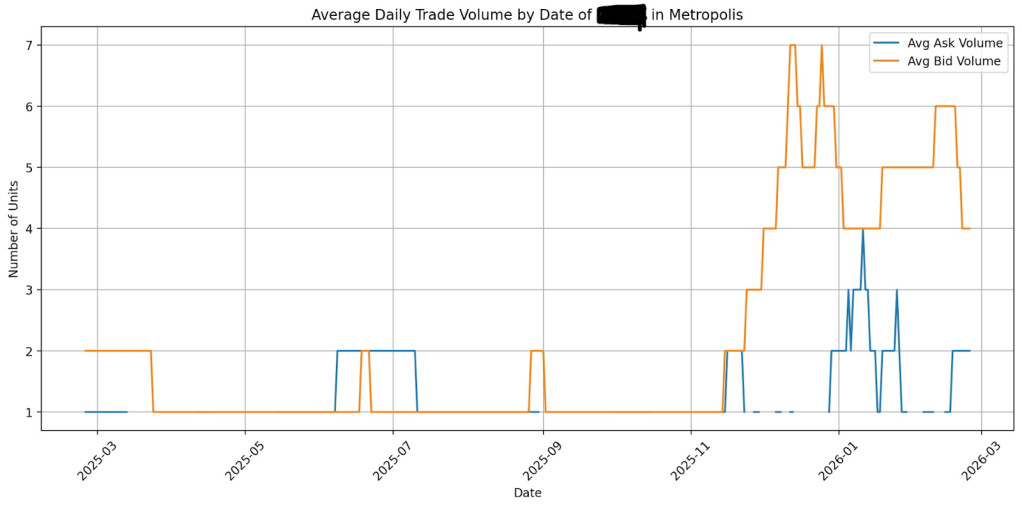
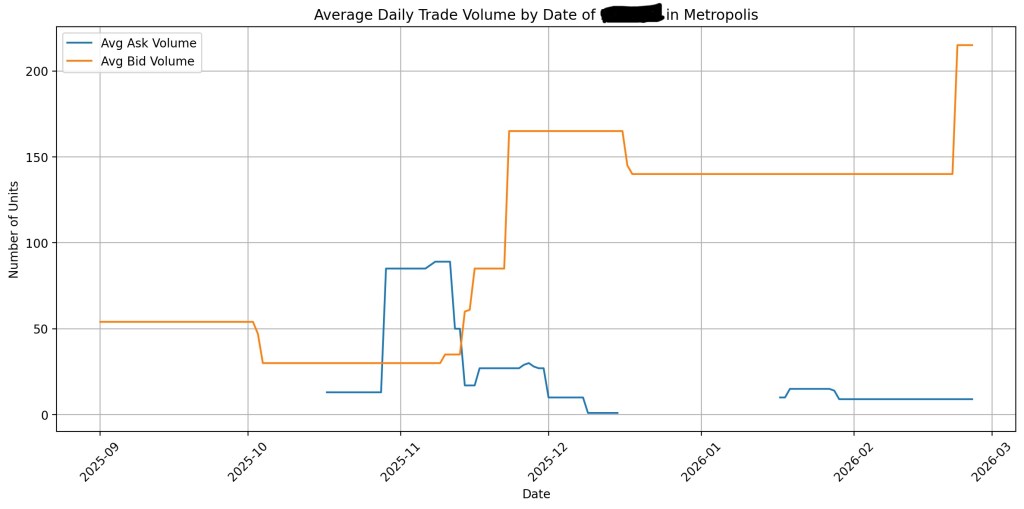
Average Daily Trade Volume by Date of a Carrier-Class Hull in Metropolis from 25/02/25 to 25/02/26Average Daily Trade Volume by Date of a Tech II Light Fighter in Metropolis from 01/09/25 to 25/02/26
Looking into a carrier-class ship, we are seeing greater bid/buy demand outstripping sell/ask volumes in Hek. Additionally, as we look into the current meta for carrier-based fighters, a similar pattern, lined up to the time around the dissolution of PanFam, but also the Carrier buff around the same time, there seems to be evidence of someone in Hek potentially trying to support internal manufacturing with external buys to be on the ready.
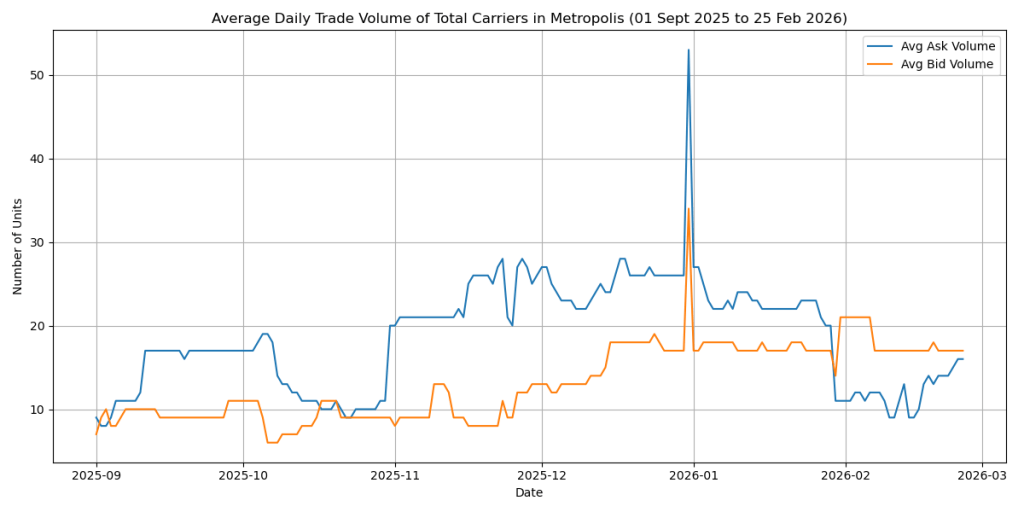
Average Daily Trade Volume by Date of All Carrier Hulls (except Vanguard) in Metropolis from 01/09/25 to 25/02/26
However, broadening the scope to all carriers, this inversion goes away and doesn’t manifest until the end of January of this year. In addition, the big spike in both curves around the end of 2025 suggests that someone was both buying and selling in great quantity. However, given that the spike is on one date and then returns to normal suggests a few things, 1) mistaken orders that were subsequently taken off the market the next day, 2) a data processing issue (the rest of the data looks good and within normal parameters), or 3) vaild short order with the intention to manipulate the market, that was was ultimately resolved the next day.
For null-bloc politics, bringing carrier hulls into hi sec trading hubs is not profitable nor possible (carriers can’t fly in hi sec) given the high-risk nature of bringing high-value cargo into low and high sec space.
If this in fact, a market driven by null sec politics, then null sec is going to start speeding up carrier construction in null sec, considering that there seems to be interest in what is fast becoming the dominant meta. There is potential that this is low sec alliances related, and that given null is quiet at the moment.
The question, of course, on my mind is why Hek? Wouldn’t it be easier to base everything from Jita? It might lie with the fact that Jita and the surrounding area are ripe for ganking squads. Hek is more out of the way in Metropolis and not as directed to as the central location for trade by CCP. Hek is also relatively close to both the Imperium and Winter Coalition null-sec territories. Which side or sides are using Hek as the base of carrier logistic prepping and without any character information attached to order books, we cannot really know. It is clear that someone with a vested interest in the dissolution of PamFam is either rebuilding through hi sec, or prepping for a future escalation.
Hek does have the new advantage of having EVEGuru’s, led by Fern Kitsuen, new industrial park in Anher. There is a good chance that Hek will further develop into the second-largest trade hub. However, given that there are rumors that CCP has plans for developing a more robust trading market, instead of having Jita be the central market, EVEGuru seems to have lucked out.
In other ways, Minmatar space is popular for Faction Warfare content, so it comes with the need for more ships. Carriers can’t roam high sec, Hek would be the primary place to at least stock up on items for FW, so they could be transported. An additional caveat is that my data is looking at region and not system, so while Hek is in Metropolis, and that is useful as a signal, we also run into that limitation, and the carriers being purchased are being traded in low sec.
The main takeaway of this brief basically comes down to if push came to shove and war breaks out, there is likely someone already prepping. If you are a null sec bloc or have vested interests out that way, it is time to start thinking about starting your preparations sooner rather than later. If you are an industrialist, it’s time to start thinking about spreading out and considering other markets that are growing.
I might be back writing (doing a bit of real-life literary writing too), so if you want to catch my market briefs, be sure to subscribe to the blog, when a post goes live. Don’t plan on having a regular day to post, so subscribing is the only way you will see everything
I’m an idiot and said that Nighthawks are Ferox T2, but alas that isn’t true. Post updated.
The big news last week was Legion’s first patch went live on Friday the 9th of this month. The patch devastated entire fleets in seconds without a single shot fired. If the destruction had occurred, the real world value destroyed would have reached the record books.
In short, the rail gun meta was significantly nerfed by the patch, along with a host of many other buffs and nerfs across the empires’ fleet of ships. The patch did more damage than perhaps the Goon/Horde “war.”
The rail gun meta has been popular from the introduction of the Ferox Navy Issue(FNI) in late 2022 until now. Three years of dominance of the hull that now has been undone, providing a more varied approach to fleet doctrines.
Is CCP no fun? Depends on who you ask, but remember EVE pretty much has unlimited ways you can play spaceships, when a meta becomes too locked into fleet composition for too long, the game becomes stale.
Stale gameplay leads to complaints and complaints result in lost subs, and you get the picture.
For today’s post, I am going to look into the FNI after my initial post in June and how the market has changed throughout the months leading up to the patch, and the initial market reaction to the nerf.
Target Scope
Target Market: The Forge
Date Range: 01-05-2025 to 15-09-2025
Commodity: Ferox Navy Issue (FNI)
Observations
As the trend lines show, the hull was generally in decline. Without much destruction, the ask volume increased, depressing the ask price.
Looking at the graph, the FNI’s decline started well before the patch, showing signs of weakness in late June when it was fast becoming obvious that the Goon/Horde war wasn’t going to continue in the same of the initial skirmishes.
On the bid graph things look more volatile, with a one day trough spiking the profit margins (below). While spiky, the profit margin values have stayed relatively stable and flat, though a precipitous fall has happened in the days after the 09-September patch.
In my earlier post in June (highlighted in sky blue), I spotted the inversion of the market, however, despite inverting again, the supply of FNIs outstrips demand.
Going into the final weeks before the patch, supply spikes to the second highest point but as the patch announcement and notes trickle out, FNIs are removed from the market.
Demand sees signs of strengthening, but the reasons why are unclear. I don’t predict for the market to fully recover given the changes in the meta.
Analysis
Is the FNI doomed for all eternity? Depends. Clearly, the current meta of railgun boats is going to change the doctrine make up going forward. Discussing this with corpmates and others online, the Vulture doctrine isn’t going anywhere. While the demand for FNIs will decrease, T1 Feroxes will continue to have use in terms of production of Vulture for fleet warfare.
To be fair to the FNI, while it’s nerfed, I don’t foresee a major crash in usage but it will have less preferential usage and create other opportunities for new ships to enter into fleet doctrines.
Given that FNIs are a separate production line and based on faction dog tags/currency and LP, I imagine demand for both the currency items and the Caldari LP, and therefore prices, will decrease, which will not be significant. The currency items and LP are often used for multiple LP store items.
Industrialists: This is your time to scale back FNI production, and start working with fleet commanders on the next set of doctrine fittings. Continue producing standard T1 Feroxes for T2 production as Vultures, which are still in use in their related game content. The FNI isn’t disappearing, rather its ubiquity is going to decrease. If you are building a large number of these you best bet is to reduce the amount you’re producing and invest production in a more diversified manner.
Station Traders: Hold any further investments into FNI until fleet doctrines start to solidify. I can’t say where to put your bets, as a dominant fleet doctrine has yet to shake out. FNIs are not going anywhere, but going forward fleets will be more varied, which for the long term health of your portfolio, start diversifying now will starve off any problems.
Overall, the markets are shifting due to the recent nerf by the patch on 09-Sept 25 and its effects on fleet composition. The markets should be able absorb this shift and I don’t foresee a crash unless another hull becomes dominant in the fleet doctrine. While change can be difficult in ship doctrine, for both the long term health of the game and the economy it is necessary.
Enjoy my analyses? Subscribe below to get my posts directly to your inbox.
This post is a week late because my boyfriend was in town last week and I chose to spend time with him. Real life always comes first.
Eve is known for its high octane, hardcore PvP culture, though more in terms of blowing up ships and ganking. Given this is a market blog, we are focused on Market PvP everyday. Today, I’m going to discuss the T2 Salvage Market, which is undergoing a pronounced shift given the recent changes in exploration.
Target Scope
Target market: The Forge
Date range: 03/07/25 – 03/09/25
Commodities:
Impetus Console
Power Conduit
Thruster Console
Single-Crystal Superalloy I-Beam
All chosen off of TheOz.Space’s The Week’s OZ Report Dashboard, under priced list for the week of September 1st.
The Data
I start off with the ask and buys of all four components and the trend is down across the board.
There are plenty of spikes and valleys but not ones that are producing strong outliers. As you can see there has been a general decrease from the start of July before the 11 July exploration patch. The rate drop differs after the date, so to apply a blanket statement on the rebalance effect, other than salvage was already going down isn’t the story here.
Spread percentages are rocky but steady but in looking at the Thruster Console, it rose 150% points from 11 July to 03 September, which was beginning of a three day dip in the component that wasn’t experienced by any other of the components studied. The most volatile component was the Single-Crystal Superalloy I-Beam with some bigger spikes but for the most part, the salvage profitability remained stable.
I went in for a deeper dive into the volume for the Thrusters Console to see if I could pinpoint what exactly happened during that initial crash on 11th.
The crash in spread was not due to a supply and demand shift, but rather the shock of the market. However, given that the shock was only evident in the Thruster Console, that should highlight the importance of the material.
Additionally, I know of at least one whale that is heavily influencing the demand in the salvage market resulting in these waves of demand that has pushed the baseline higher.
Analysis
With the Thruster Consoles being prime materials in velocity rigs, the need for them is one of constant demand. For the markets, demand is currently high, whether this actual demand for production demand versus speculators in the market is quite another thing.
Salvage is known for intense speculation. Sir SmashAlot is well known in the EVE station trading community, who is regularly featured on Twitch streamer and market commentator Oz, for being a trillion ISK salvage speculator. Clearly some of the demand above is related to Sir SmashAlot getting into the market at a time when the spread percentage crashed, thus making it much easier to increase demand and move the needle in terms of baseline demand.
It should also be noted that, demand has not consistently outstripped supply, which suggests that the whales are biding their time to collect and then dump at the right time or at least release in spurts to not overwhelm the market.
Given the market is flush and healthy and so is production, there should be no problems with salvage prices becoming volatile overall. While supply is getting further buffed, this will depressed prices, at least for the moment, so again whales are building a stockpile.
This generally means we are going to see hull prices continue to sink and may offset some of the pyerite costs.
Recommendations
Explorers: Amass your salvage and hold onto these items until they are worth more. I would prioritize data sites over relic sites because the data market is still solid, but given the exploration changes affect both types of exploration sites, it is likely data salvage is also likely getting depressed as well.
Station Traders: This is a buy and hold situation. I don’t see spread really opening up until the prices stabilize and CCP finding equilibrium in the salvage markets vs production.
At the end of the day, it’s a lot of whales moving the markets but I would argue to hold onto your salvage until there’s better stabilization of the drop rates and production rates really ramp up.
Enjoy my analyses? Subscribe below to get my posts directly to your inbox.
Welcome back to Auric Quanta Strategies’ Market Analysis blog. I have been away in real life enjoying my summer and ready to head into the fall strong. I am going to ease back into posting and only post on Thursday for the next few weeks and we will see how the rest of my schedule in real life, corp and business life, and FFXIV all mingle, because somehow I have to keep moving mountains while getting enough sleep.
The July Monthly Economic Report came out this Monday, the 18th of August, which is very late. Supposedly, CCP had issues with their data processing, which seems odd to me that they have such issues given the vast amounts of data they produce with ESI.
The hot topic on everyone’s mind is the status of Pyerite. CCP buffed the output of Pyerite by 10% from Scordites and Morduniums on the 31st, after buffing it in late June.
Pyerite is a foundational mineral in T1 hulls and modules, though T2 hulls and modules are not as constrained by the lack of pyerite on the public markets. So without pyerite, industry begins to halt and there in lies the problem. No ships and modules to build, it becomes more expensive to fly.
Other minerals continue to push the Mineral Price Index down, but the price of Pyerite remains fixed at around 30 ISK, which CCP has deemed too high of cost.
This calculus is informed by the fact that production, both primary (reactions, ore reprocessing, PI, the like) and secondary (modules and hulls), is down in terms of their price indexes and very dramatic fall in terms of production value. However this indicates that the markets have not lost a lot of value, and thus production remains to be viable in the market.
But what does this mean for pyerite and CCP’s push to drive down prices?
Effectively, CCP is trying to push commodities and finished products’ prices lower to effectively make it cheaper and easier to fly, which means more ISK flow and, potentially, more PLEX purchases and redemption.
However, given the multiple buffs of pyerite, supply and demand have not fully reconciled. Looking at the graphs below, there is an uptick in mining value and there is an upswing in asteroid mining volume in null sec after a significant decrease in June suggesting that the alliance shuffle and moves have completed and mining resumes at rates more in-line with numbers from March.
However, key in this is that null sec mining is up, not high sec, and given that asteroid ore that melts into pyerite is not very common in null, means CCP’s attempts to get miners out on the belts will have limited success, at least outside of high sec.
That may be strategic on CCP’s part to get new players a piece of the action they need to get going into solidifying their engagement. The moneyed oldbies and industrial titans need to realize they cannot sustain EVE’s business model indefinitely and that investors in Pearl Abyss cannot wait much longer for EVE to remain a niche of a niche world. That’s the unfortunate reality of late stage capitalism.
Additionally, the MER does not take into account private contracts and corp/alliance buybacks, so it might be making pyerite from CCP’s point of view scarcer than it really is on the ground. This then would explain why the Mineral Price Index and production price indexes are not falling at an even pace. This again suggests that CCP wants newbros actively producing and often times don’t have a strong corp presence.
Takeaways
Miners – Get out on the belts and pop those R4 moons. This is prime opportunity time to get lots of ore in high sec. Low sec also needs mining activity but considering low sec is as, if not more, dangerous than null and sov null these days, do take a few big guns out with you. Low sec has more Mordunium, which reduces into purely pyerite, so if you don’t have access to R4 moons, this is a prime reason to be out in low sec.
Industrialists – No big takeaways other than continuing to produce at the rates you are at right now. If you are short on pyerite and don’t have access to cheap pyerite and/or don’t feel like dealing with the public markets, shift your lines to less intensive pyerite blueprints and focus on salvage now that has effectively lost value on the market given the recent changes in exploration.
Newbros – It’s your time to shine. Get those Ventures mining Scordite, but also fire up the manufacturing modules and get producing. To be super successful takes time, but give it a go and see how it feels!
In short, we will have to sit tight and see how the recent buff on pyerite is ultimately consumed in production in August but we won’t know until the August MER report is released next month.
Enjoy my analyses? Subscribe below to get my posts directly to your inbox.
CCP dropped the Monthly Economic Report (MER) for June in the morning (USTZ ET) of July 10th.
There are some nice market nuggets inside the report and at least two I’ll highlight here.
The Data
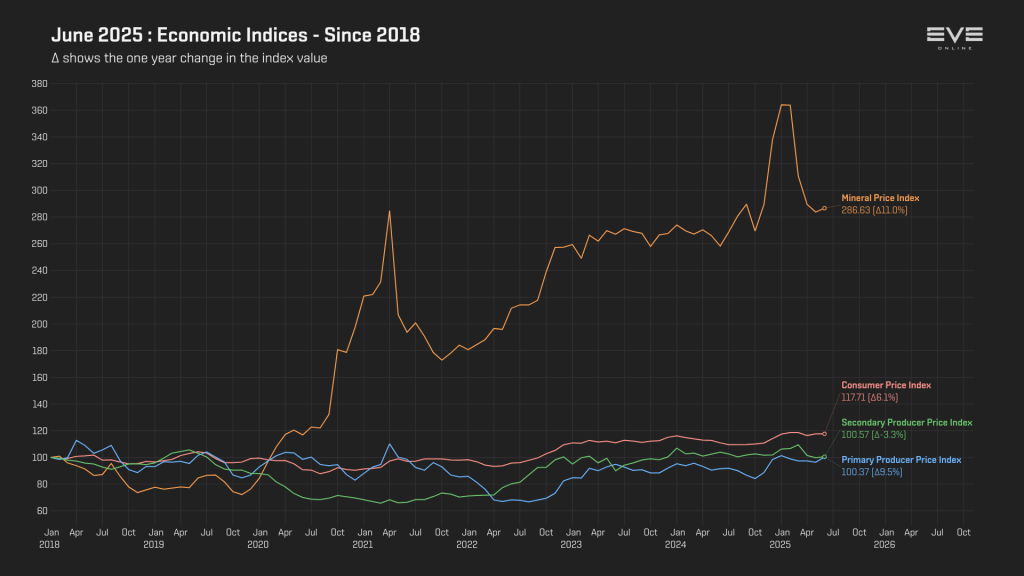
Mineral Price Index rose 9.5% suggesting that 1) the pyerite buffs had limited effect on the monthly index since they were late in the month, 2) according to analysis by Oz, pyerite bounced and went back up to pre-patch levels, 3) if pyerite is not the influencing mineral, there’s another shortage somewhere in the markets that’s causing a small rebound.
Primary production (so reactions, mining reprocessing, and assorted production) is up 9.5% while secondary production (modules, hulls, components, etc) were down 3.3% suggesting somewhere there’s a production blockage.
Mining value is also down significantly, correcting from the big boom in May.
Analysis
Overall, the markets are starting to correct from the highs of May. This suggests that war preparations were well under underway in May, and if people were watching the markets close enough, industrialists might have been able to keep themselves from losing money on the markets as demand would eventually end, and production lagging behind demand. This puts my post on the Ferox Navy Issue hull within a broader context, because the producers that were early on the markets were the most successful at getting the best ask price.
While the battles between the PandemicHorde and Imperium were large, the sheer lack of battles turned them ultimately into skirmishes, thus reducing destruction and reducing demand.
In addition, the lack of pyerite in the market has also hamstrung production efforts with industrialists, probably lightening their load of production to strictly items without large quantities of pyerite needed or only producing only needed items that need pyerite. This is also emblematic of a situation where the fleet stock was already high and that those that saw the pyrite crunch coming, were likely over producing in advance.
The lack of minerals is also likely due to lower mining values because of lack of full scale mining ventures out in the belts. This likely due to the most recent null sec reorganization and movement, which suggests other minerals are going to get squeezed similar to pyerite.
I’m already seeing some evidence in the mexallon markets of an inflation of demand so until null sec movement settles down, I suspect the mineral market and the EVE Mineral Price Index will continue to rise.
Takeaways
Miners: If you aren’t already mining for pyerite, and to a lesser extent mexallon, get out to the fields. Feel free sell directly to bids because this point that is where the biggest demand is. If you aren’t part of the sov null and generally stay in high or low sec, you should be able to capitalize.
Industrialists/Producers: Formalize contracts with miners (or freelance jobs) to get minerals to you. The market is still trying to find where it will land, especially after the patch, and the market doesn’t seem to be willing to let pyerite to relax. Since that is the case, I would recommend staying off the markets and continue to work through contract.
Traders: If y’all are reason that pyerite is not settling, let it go before you crash the entire economy (at least on the market boards). Pyerite is crucial to the game and why CCP is willing to inflate the availability. The minute it gets expensive to fly ships, the minute everything around the game stalls content-wise. Not everyone has billions and trillions of ISK in reserve and the real world economy is starting to slow, that creates a very risky situation for CCP and EVE, who rely on PLEX purchases and subs, and the minute it becomes more expensive to play, more players will drop out of the game.
Like my analyses and want to keep up with my posts? Consider subscribing and get the post sent directly to your inbox!
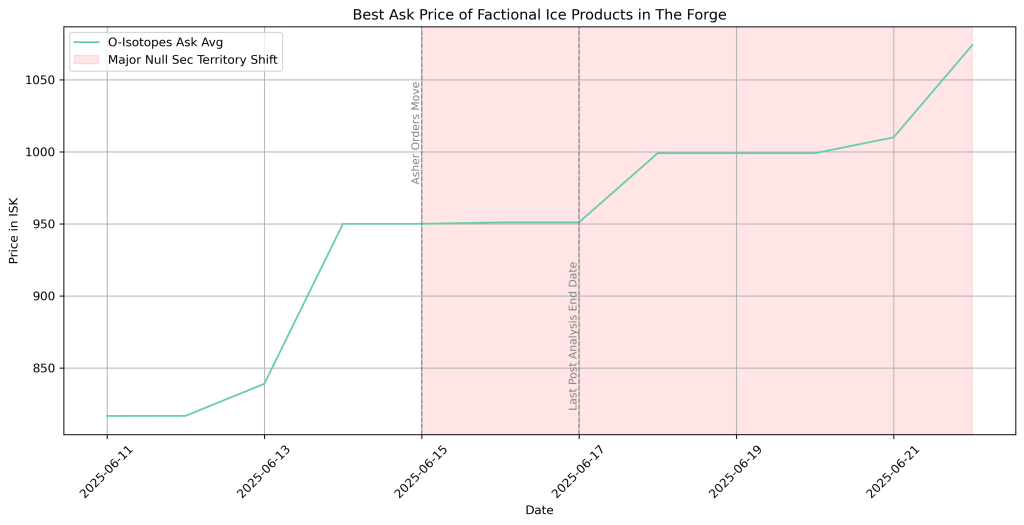
It is hot, humid, and sunny today where I live, but also things in Jita are also hot on the Ice Product market with O-Isotopes correcting course as Null Sec alliances play musical regions. Let’s get right into the graphs for today’s short update post.
Market Scope
Commodity: O-Isotopes
Time Frame: June 11-22
Market: The Forge
Observations
First a clarification, I have been using the ask/bid/volume high values, however it was not the best measure I could be using to understand the markets long term or shifting through the noise of prices or volumes that were outliers. Going forward, I’ll be using ask/bid/volume average values to better track long term trends, and find the signals with greater clarity. Better Analysis = Better Outcomes
As you can see in the graph below the Ask Price has plateaued twice, but on the 20th the price started rising. From 17-22 of June, the price has risen 13.08%.
The bid price has also been rising, however, that has only risen 3.72% since the 17th, which was the end date to my Thursday market post, which has only plateaued on the 21st.
The compression from the flat ask, rising bid price from last post has rebounded and while the number is less than the initial rebound the spread % difference is still very high, with a rise of 1626%.
If we look at the Volume Dynamics of O-Isotopes, we are seeing a closing in on inversion again. Clearly, miners feel comfortable with now selling their refined ice products on the Ask market rather than going directly to the buyers that need the ice.
Analysis
Clearly with multiple moves happening in Null Sec, the price is increasing, but we are seeing the rise in ask volume. The abundance of buy orders is now for the most part over given moves are finishing their final stages and thus O-Isotopes are no longer needed.
Miners will have to be careful not to over sell the market because that could create a problem for traders, so given the trends in the market, I am forecasting that the market will invert, driving prices and spread down once again.
Recommendations
Miners can still sell directly to buyers, but be careful in adding to the Ask Volume.
Traders, this is not an investment, unless you are going to buy into the dip, but honestly, I would hold off.
Until the market can stabilize, I suggest waiting for any real investment either in product or trading. Additionally, I expect a dip in spread, however, I don’t expect a deep negative spread coming like on the 17th, but given the fact the Null Blocs are solidifying their new territories, demand and price pressures should be easing on both sides and there should be a stabilization of the ask/bid prices.
Part of a Null bloc, what is your take on this? Is the price growth hampering your wallet? Miners, what is your preference, either sell directly to buyers, or are you going more towards the ask market? Comment below.
[Early Correction]: Goons are moving, just not to Delve. Wires got very crossed do to getting intel from different places, but also real life has been very active with a lot things going on, thus shifting attention there rather than in EVE.
The economic war machine must feed, and I found some timely intel on ice and ice product trends on Reddit—perfectly coinciding with the revelation that Asher Elias has ordered the Goons to move.
Earlier this week (Monday), I shared a preliminary graph and post on Reddit. Admittedly, my initial numbers were off due to some less-than-stellar programming on my part. However, the core market trend remained valid, and after finalizing the data through Tuesday, June 17, there’s plenty to report.
Market Scope
Commodities – Factional Ice Products
H – Isotopes
He – Isotopes
N – Isotopes
O – Isotopes
Time Frame – 01 June to 17 June 2025
Market – The Forge
Observations
The market for ice products has and is highly volital and the move order did nothing to help things.
As you can see while the ask price stays relatively stable for everything but He-Isotopes. However, the bid prices for all shoot up.
The spread percentage graph is a graph of valleys and peaks:
He-Isotopes (June 15–17)
Bid Price: +23.56%
Ask Price: +44.65%
Spread %: +269.46%
O-Isotopes (Same Time Frame)
Bid Price: +26.73%
Ask Price: +0.11% (flat)
Spread %: -222%
For the Volume graphs, we see strong demand for He-Isotopes
Standard inverted market, when Ellis gives the command to move the He-Isotopes Ask Volume jumps nearly 600%.
The O-Isotope market shows inversion, but if you look back to the spread percent, this should create a situation where the ask price goes up because the margin should be greater than a loss. However, the ask price remains flat and the bid price spikes causing margins going far down.
Analysis
For O-Isotopes, demand appears driven by aggressive, even desperate, acquisition strategies. Ask prices have flatlined, creating a compression scenario, buyers want in, but sellers aren’t moving enough product.
This fits with logistics trends: the Goon freight fleet relies heavily on Gallente ships, requiring large volumes of O-Isotopes. The limited ask volume isn’t enough to support a major fleet move. While traders briefly increased volume, that surge collapsed almost immediately.
Meanwhile, the Amarr-based He-Isotope market is behaving more normally, following expected logic under stress.
Recommendations
For Traders:
This is a bad market to be in, at least for O-Isotopes. If you’re late to the Helium play, that ship may have already sailed. I expect the market to correct soon as the move completes. If you are already committed and are selling, raise your prices ASAP, otherwise you might miss the benefits.
For Miners:
Now’s your moment. Hit the high-sec factional ice belts hard. Push back against bots, farmers, and bullies. With null sec heating up again, we may be watching the start of a “Roman Empiring” scenario, where Goon sovereignty stretches too thin. (Special thanks to u/PomegranateSlow5624 for rallying miners in Monday’s Reddit thread.)
The command to move into Delve didn’t just ignite military logistics, it sent shockwaves through the ice product markets. The bid-ask spread behavior, volume shifts, and compression dynamics reveal deeper patterns about faction fleet preferences, supply chain stress, and speculative surges.
Helium-Isotopes may have already crested, but Oxygen-Isotopes are showing signs of dangerous compression—a situation where traders risk squeezing margins into the red, especially as ask volumes stay stagnant.
I will continue monitoring these disruptions across regional markets and commodity types. This analysis is part of my ongoing commitment to delivering grounded, actionable economic intelligence for capsuleers who want to stay ahead of the curve.
Want targeted insights for your corp, alliance, or industrial logistics? Commission a custom market report or subscribe to weekly updates at auricquantastrategies.space
Spotted something in the market I didn’t? I welcome feedback, counterpoints, and collaboration. Let’s make sense of New Eden’s economy together.
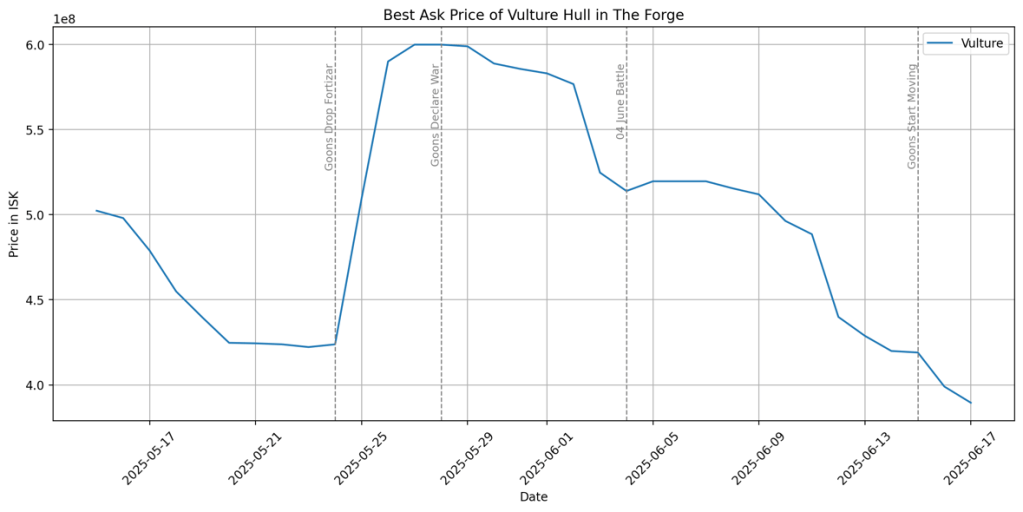
Before I drop the Auric Intel Report preview later this week, here’s a snapshot of the Vulture market:
📉 Ask prices down 30% (28 May – 15 June)
📉 Bid prices down 22% (28 May – 15 June)
We’re seeing fast-moving price action and likely early signals of a doctrine shake-up or at least a signal the Horde is uninterested in the Goons. Stay sharp.
🗓 Friday: Report preview and goes live
📦 Later this month: Full Vulture doctrine breakdown
→ Make sure you’re subscribed so you don’t miss the drop.














 Auric Quanta Strategies